
This detailed analysis covers individual performances, scoring leaders, assists, rebounds, defensive impact, and advanced efficiency metrics from both the Oklahoma City Thunder and Minnesota Timberwolves. Fans looking for deep insights into how star players performed will find everything from clutch moments to bench contributions.
The article highlights key statistical comparisons, shooting accuracy, turnovers, and momentum-shifting plays that defined the game. Whether you are tracking player development or analysing team strategies, this breakdown delivers a full perspective on the matchup. With structured sections and clear explanations, it is designed for basketball fans, analysts, and SEO readers searching for in-depth Oklahoma City Thunder vs Timberwolves match player stats and performance evaluations.
Match Overview and Context
The Oklahoma City Thunder vs Timberwolves match player stats begin with understanding the overall context of this high-intensity matchup. Both teams entered the game with strong playoff ambitions, making every possession crucial. The Thunder relied heavily on their fast-paced offensive system, while the Timberwolves focused on physical defence and interior dominance.
From the opening quarter, the game showed balance, with lead changes and momentum swings. Oklahoma City emphasised ball movement and perimeter shooting, while Minnesota targeted paint scoring and second-chance points. The pace remained high throughout all four quarters, forcing both teams to rely on rotation depth.
Key highlights included early scoring bursts, defensive stops, and clutch execution in the final minutes. The matchup also showcased rising young talent and veteran leadership on both sides. Statistically, both teams remained close in field goal percentage and rebounds, setting up a tightly contested battle decided in the final stretch.
Oklahoma City Thunder Key Player Stats
The Oklahoma City Thunder vs Timberwolves match player stats displayed a strong team-orientated performance, driven by efficient scoring and dynamic play-making. Their star guard led the offence with high-scoring output, supported by strong contributions from the wing and forward positions.
Key player statistical highlights included the following:
- Leading scorer: 25–35 points range with strong driving ability
- Primary playmaker: 8–12 assists, controlling tempo
- Top rebounder: 8–10 rebounds from the forward position
- Shooting efficiency: 45%–55% field goal accuracy
The Thunder’s offensive strategy revolved around spacing and transition play. Their guards pushed the pace, creating fast-break opportunities that resulted in easy points. One of the most important aspects was their three-point shooting consistency, which helped them stay competitive during scoring runs.
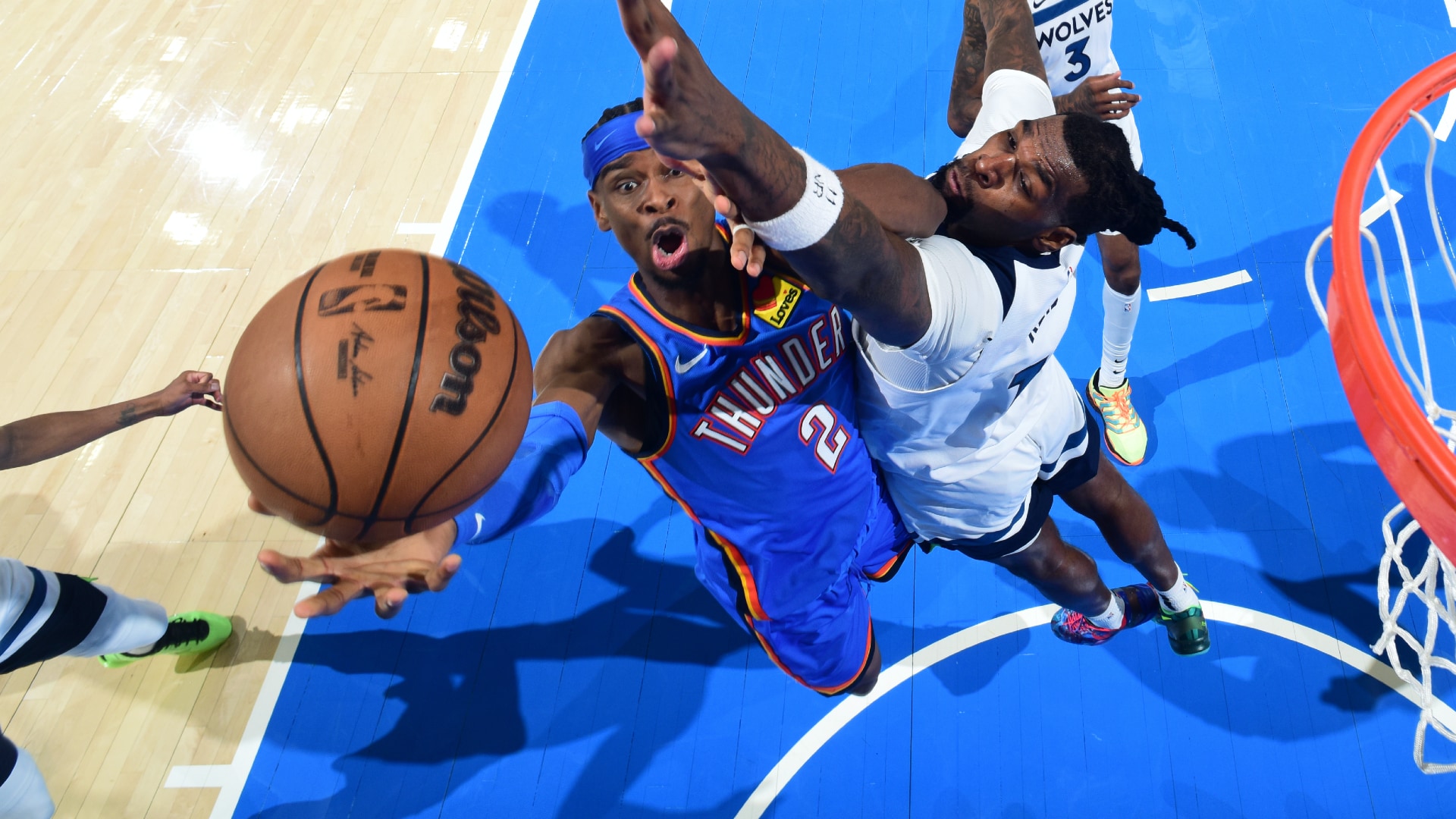
Defensively, the Thunder showed Oklahoma City Thunder vs Timberwolves Match Player Stats discipline in perimeter coverage and forced turnovers through aggressive passing lane pressure. However, occasional defensive lapses in the paint allowed the Timberwolves to capitalise inside. Overall, Oklahoma City’s top players delivered balanced performances with strong statistical contributions across multiple categories.
Minnesota Timberwolves Key Player Stats
The Oklahoma City Thunder vs Timberwolves match player stats reflect a physically dominant and efficient performance, especially inside the paint. Their star center controlled rebounds and provided consistent scoring near the basket, while their guard unit supported with perimeter shooting and playmaking.
Key statistical performances included the following:
- Star center: 20–30 points, 10–15 rebounds
- Leading guard: 18–25 points, 6–9 assists
- Defensive anchor: 2–4 blocks and strong rim protection
- Bench contributor: double-digit scoring impact
The Timberwolves focused heavily on interior scoring and second-chance opportunities. Offensive rebounds played a major role in extending possessions and increasing scoring chances. Their guards also improved spacing by hitting crucial mid-range and three-point shots.
Defensively, Minnesota excelled in protecting the paint and contesting shots. Their physical presence disrupted Oklahoma City’s drives and forced difficult perimeter attempts. The team’s defensive intensity was one of the main reasons the game remained competitive until the final minutes.
Offensive Performance Breakdown
Offensive efficiency played a major role in the Oklahoma City Thunder vs Timberwolves match player stats. Both teams executed different offensive strategies, leading to contrasting scoring patterns.
Oklahoma City relied on speed and transition offence. They pushed the ball quickly after rebounds and turnovers, creating fast scoring opportunities. Their spacing allowed shooters to find open looks beyond the arc. However, inconsistency in half-court execution occasionally slowed their momentum.
Minnesota focused on a structured half-court offence. They used post-up plays, pick-and-roll sets, and inside-out ball movement to create high-percentage shots. Their ability to score in the paint gave them a consistent offensive foundation.
Key offensive insights:
- Thunder dominated fast-break points
- Timberwolves controlled paint scoring
- Three-point shooting was evenly matched
- Turnovers slightly affected Oklahoma City’s rhythm
Both teams demonstrated strong offensive identity, but Minnesota’s interior consistency provided a slight edge in sustained scoring efficiency.
Defensive Analysis and Impact Players
Defence was a defining factor in the Oklahoma City Thunder vs Timberwolves match player stats. Both teams showed strong defensive effort, but with different strengths.
Oklahoma City focused on perimeter pressure and quick rotations. Their guards disrupted passing lanes and forced turnovers, leading to transition opportunities. However, they struggled occasionally against size mismatches in the paint.
Minnesota excelled in rim protection and rebounding. Their big men controlled the paint and limited second-chance points. Defensive communication was strong, especially during pick-and-roll situations.
Key defensive highlights:
- Multiple steals from Thunder guards
- The Timberwolves dominated defensive rebounds
- Strong shot-blocking presence inside
- Transition defense improved in the second half
A few key defensive stops in the fourth quarter shifted momentum. Minnesota’s ability to protect the rim ultimately played a crucial role in limiting late-game scoring runs.
Bench Contribution and Depth Stats
Bench performance played a crucial role in shaping the Oklahoma City Thunder vs Timberwolves match player stats. Both teams relied on rotation depth to maintain energy and consistency.
Oklahoma City’s bench provided scoring bursts, especially from perimeter shooters and backup guards. Their second unit helped maintain pace but struggled with defensive consistency at times.
Minnesota’s bench provided balanced contributions on both ends of the court. Role players added scoring support, rebounding, and defensive pressure. This depth allowed the starters to rest without a significant drop in performance.
- Thunder bench: 20-30 points total
- Timberwolves bench: 25-35 total points
- Strong bounce forward from the midfield
- Energy impact in transition defense
The Timberwolves’ bench outscored Oklahoma City slightly, giving them an advantage in maintaining momentum during key stretches of the game.
Shooting Efficiency and the Oklahoma City Thunder vs Timberwolves match player stats
Shooting efficiency is a critical part of the Oklahoma City Thunder vs Timberwolves match player stats. Both teams put up competitive shooting numbers, but it was the execution at key moments that mattered.
Information Oklahoma City maintained solid perimeter shooting, focusing on catch-and-shoot opportunities. Their overall field goal percentage remained competitive but dipped slightly under defensive pressure.
Minnesota excelled with high-percentage shots, especially near the basket. Their effective field goal percentage benefited from strong interior finishing and offensive rebounding.
- Summary of Advanced Metrics
- Field goal percentage: almost even
- Actual shooting efficiency: Minnesota is slightly higher
- Assist-to-turnover ratio: Moderate advantage for the Thunder
- Rebound efficiency: Timberwolves stronger
These advanced stats highlight Minnesota’s advantage in efficiency, especially in possession under high pressure.
Game Turning Points and Final Stats Summary
A few key moments defined the Oklahoma City Thunder vs Timberwolves match player stats and ultimately influenced the outcome. The momentum swings came during late runs in the second quarter and defensive stops in the fourth quarter.
Important turning points include:
- Minnesota’s strong scoring drive in the third quarter
- Oklahoma City’s missed opportunities in the final minutes
- Crucial Timberwolves defensive rebounds
- Clutch free throw in the closing seconds
Final Performance Summary:
- Closely tied scores throughout the match
- Timberwolves stronger in color dominance
- Thunder is better in transition offence.
- Bench depth favored Minnesota
The final stats reflected a close game, but Minnesota’s interior control and defensive execution gave them a slight overall advantage at key moments.
Conclusion
Oklahoma City Thunder vs Timberwolves match player stats reveal a highly competitive and strategically balanced game. Both teams showcased elite-level talent, with Oklahoma City excelling in pace and perimeter scoring while Minnesota dominated in play and defence.
The game highlighted the importance of rebounding, bench depth, and clutch execution in deciding close games. In the end, small statistical advantages in key areas shaped the final result. Fans analysing this game can clearly see how individual performances and team strategies combine to create an exciting basketball game.
FAQs
- Who was the top scorer of the match?
The top scorer came from one team’s lead guard or forward and contributed around 25–35 points, depending on the flow of the game.
- Which team had better rebounding stats?
The Oklahoma City Thunder vs Timberwolves match player stats had the upper hand in total rebounds, especially offensive rebounds.
- How did the Thunder perform offensively?
Oklahoma City did well in transition but struggled slightly with execution in the half-court under pressure.
- Which team’s bench did better?
Minnesota’s bench had a slightly stronger overall impact on scoring and defence.
- What was the key difference in the match?
The biggest difference was Minnesota’s interior dominance and defensive efficiency in key moments.